
When you buy property in Spain from abroad, the listing, the agent and the photos all come from the seller's side. The one document that comes from the State is the Land Registry extract — the nota simple. It is basic, cheap and essential, and it is exactly where expensive surprises show up. This is a real case from October 2026, anonymised, of what that check uncovered for a foreign buyer.
The case: four holiday homes in a coastal complex
A foreign buyer ordered our Full Report + Land Registry study for a plot in a holiday complex on the Spanish coast. The Cadastre — Spain's tax and mapping register — listed four independent homes on the plot, each with its own cadastral reference and a 25 % share. The plan was to buy all four.
Step 1: the Registry did not recognise the address
Our first requests to the Land Registry, using the street address and the cadastral references, were all rejected: the Registry could not identify the property. This is common with developments from the 1990s, where the Registry still describes properties in its own terms (plan, plot number, boundaries) and the cadastral reference was never linked. Many 'instant' websites would simply have charged the buyer and returned nothing — or the wrong property.
Step 2: finding the property through its holiday-rental number
The holiday-rental listing showed the property's short-term rental registration number. That number embeds the property's unique registry code, which led us to the registered owner (a company) and, through a search by owner, to the registered property itself. One correct request later, the Registry issued the extract.
What the extract revealed
- One single registered property, not four. The Registry describes a building of four bungalows with no horizontal division registered. Buying all four means buying the whole property — fine. But selling or mortgaging any of them separately later would first require executing and registering a horizontal division, with its own cost and timescale.
- Tourist use, not residential. The Cadastre classifies the homes as leisure and hospitality, and the extract lists four holiday-rental licences. That matters for living there, for keeping the licences after the sale, and for the price: most published price references are for ordinary houses.
- Clean title. Owned outright by one company, no charges in force (an old tax lien had expired years ago), no documents pending registration, and the registered areas matched the Cadastre.
What this means if you are buying from abroad
- Never rely only on the listing or the Cadastre. The Cadastre describes the physical property; only the Land Registry says who owns it, what debts come with it and whether it can be sold the way it is being offered.
- Get the extract before paying a deposit. In Spain the deposit contract (arras) is usually signed early; once signed, walking away can cost you the deposit.
- Beware of 'instant nota simple' websites. Many are resellers that charge several times the official fee, or sites that never deliver. The genuine extract is issued by the Land Registry and usually takes from a few hours to one or two business days.
- Ask what the extract does not say. It will not tell you about flood zones, overhead power lines, airport noise or planning restrictions. That is what the rest of the Hogarfax report covers.
- Review it with a lawyer or notary before signing. The extract and our study are informative; they are not legal advice.
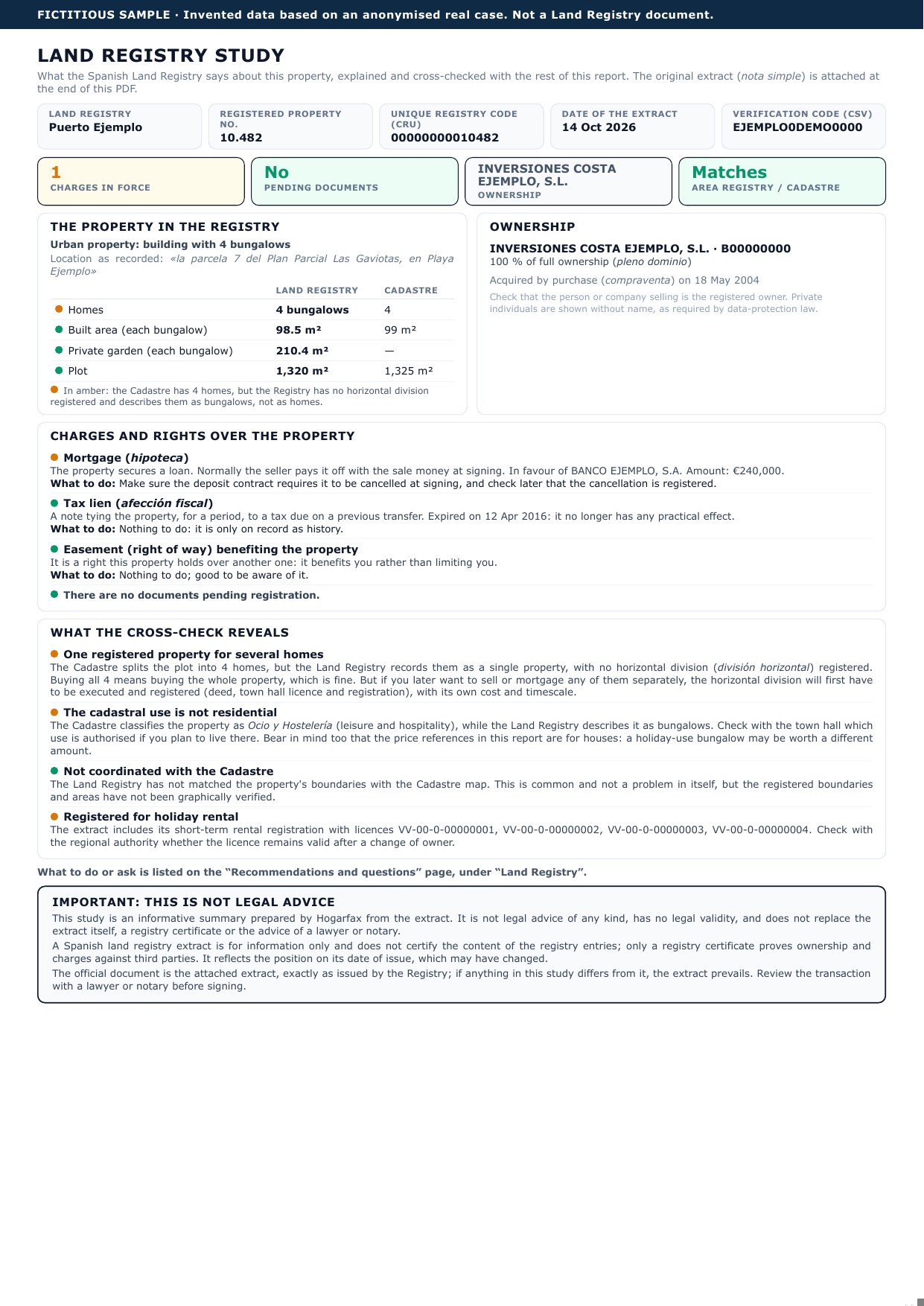
More than 80 buyers have already ordered a Hogarfax report, and Land Registry studies like this one are now part of the service: we request the genuine nota simple on your behalf, explain it in English on one page of your report, and attach the original extract unmodified.
Check the property before you commit
Full Report + Land Registry study: the official nota simple, requested from the Registry on your behalf and explained in English, plus flood, fire, noise, planning and price checks. €89 (VAT included). Usually delivered within 1–2 business days.
Analyse a propertyFuentes
www.boe.es/buscar/act.php?id=BOE-A-1946-2453
Was this article useful?
Your answer helps us improve the blog and understand which guides deserve more depth.