
The nota simple tells you who owns a Spanish property and what charges come with it. The catch is that it is written in registry Spanish: areas spelled out in words, «afecciones», «servidumbres por procedencia» and a legal footer longer than the information itself. This guide walks through it section by section with an example, and shows how Hogarfax explains it when you order the report with the Land Registry study.
1. Identifying the property
At the top you will find the Land Registry office that issued it, the registered property number (finca registral) and the unique registry code (CRU) — the property's ID in the Registry, unrelated to the cadastral reference. Check the date of issue too: the extract shows the position on that day, and nothing stops something new from being registered tomorrow.
2. The description: what the Registry says you are buying
This is the type of property (home, commercial unit, plot…), its location and its areas, usually written out in words: «noventa y ocho metros con cincuenta decímetros cuadrados» is 98.50 m². Four checks almost nobody makes:
- Does the area match the Cadastre? They rarely match to the decimal, but a large gap is a question for the seller before the deposit contract.
- One property or several? If the Cadastre splits the plot into several homes but the Registry has no horizontal division (división horizontal) registered, they all form a single property: you cannot sell or mortgage one separately without registering that division first.
- Coordinated with the Cadastre? The extract states whether the boundaries are coordinated. Not being coordinated is common and not a problem in itself.
- Holiday-rental registration? Since 2025 the extract may include the short-term rental registration number. If you plan to live there, confirm the authorised use.
3. Ownership: who can actually sell you the home
It shows who is the registered owner, in what share and with which right (full ownership, usufruct, bare ownership…), plus how they acquired it. The rule is simple: whoever signs the sale must be the registered owner, or hold sufficient power of attorney. If there are several owners, all of them must sell.
4. Charges: what travels with the property
- Mortgage (hipoteca): normally the seller pays it off with the sale money at signing. Put it in writing in the deposit contract and check afterwards that the cancellation is registered.
- Seizure or preventive annotation (embargo / anotación preventiva): a debt or proceeding noted against the property. Do not sign unless it is lifted or its amount is withheld.
- Tax lien (afección fiscal): ties the property for five years to a tax due on a previous transfer. Once the period has passed it has no practical effect; if still in force, ask for proof of payment or exemption.
- Easements (servidumbres): check whether they benefit your property (a right it holds over another) or burden it (someone else's right over yours).
5. Documents pending registration
The shortest line and one of the most important. If documents are submitted and pending, something is being registered right now — a sale, a seizure, a mortgage. Do not sign without knowing what it is.
How Hogarfax explains it: an example
When you order the Full Report + Land Registry study, we request the nota simple from the Registry on your behalf and turn it into page 2 of your report, in English or Spanish. Below is a sample page with invented data based on an anonymised real case: a building of four bungalows that the Cadastre treats as four homes but the Registry records as one single property, with a mortgage in force, an expired tax lien and an easement benefiting the property.
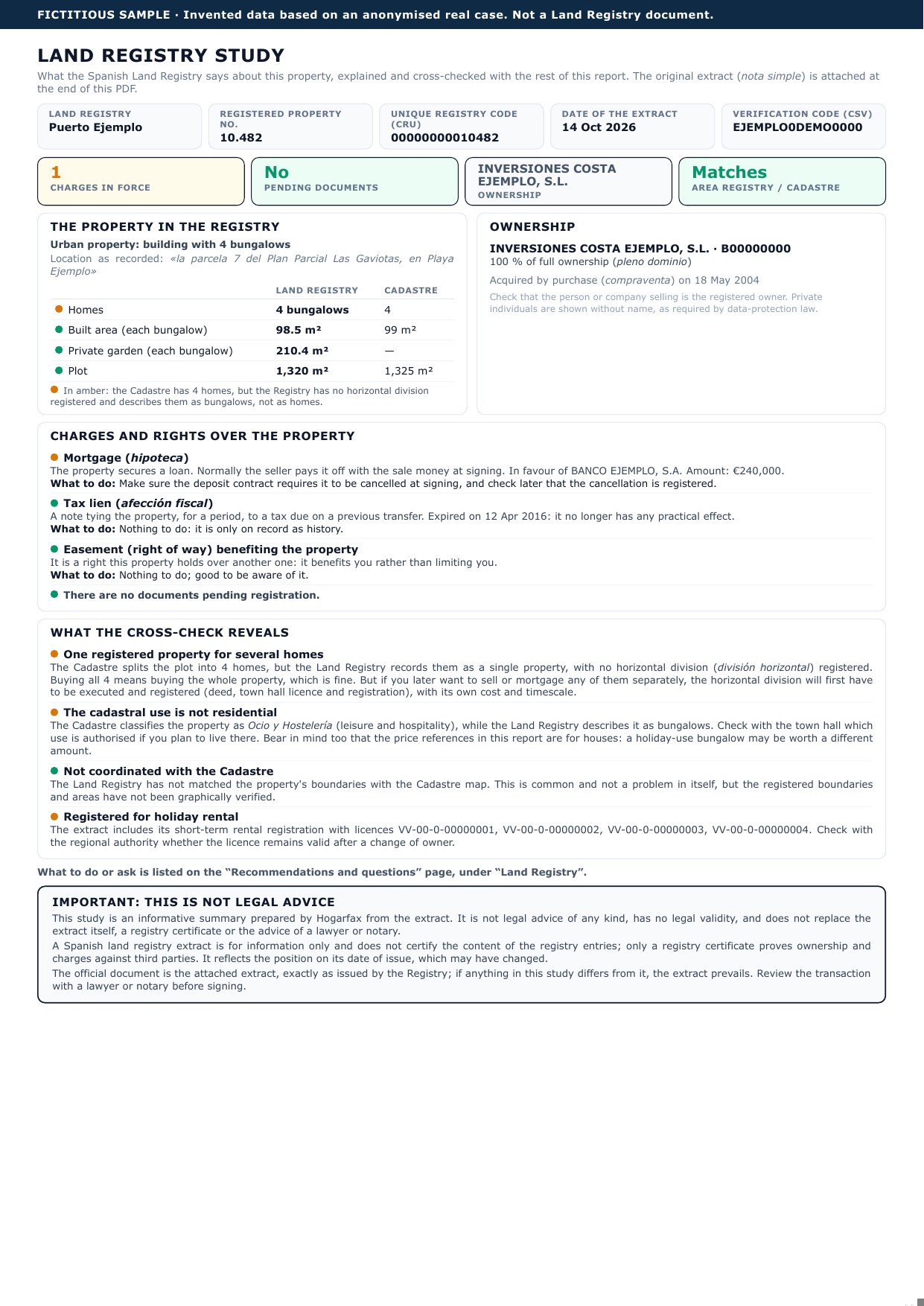
With every extract we keep only what matters for buying and leave out the standard legal text. We explain each charge, cross-check it with the Cadastre and move whatever needs checking to the final recommendations page. The original extract is attached at the end of the PDF exactly as issued by the Registry. As data-protection law requires, private individuals are never shown by name.
The nota simple, requested and explained for you
Full Report + Land Registry study: the official nota simple, requested from the Registry on your behalf and explained on one clear page, together with the property's risks, surroundings and price. €89 (VAT included). Usually delivered within 1–2 business days.
Analyse a propertyFuentes
www.boe.es/buscar/act.php?id=BOE-A-1946-2453
Was this article useful?
Your answer helps us improve the blog and understand which guides deserve more depth.