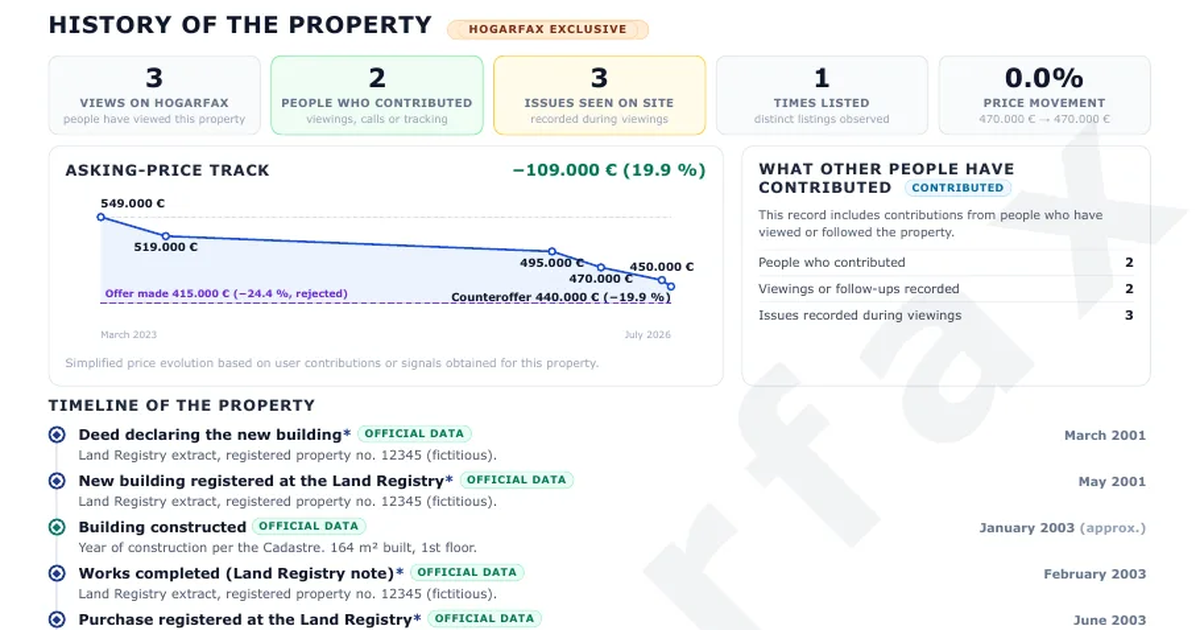
A foreign buyer was about to make an offer on a three-storey house in a village in Aragón, Spain. The listing presented it as a single home with its storage room. In the Cadastre and the Land Registry it wasn't: it was two separate properties. This is the case, told with real anonymised data, and what the buyer knew before signing.
What the listing said and what the Cadastre says
The listing described a house with a storage room and a round figure of built square metres. Analysing the cadastral reference, the Hogarfax report found the home on one plot and the storage building with its yard on another, adjoining plot with its own cadastral reference. For the buyer it was “the house”; for the Cadastre, two properties.
This is more common than it seems, especially in villages and on the coast: the garden, pool, garage or a storage building were bought or built later and ended up on a different property. The problem comes if the deed only includes one of them: the other part does not come with the purchase, even if you viewed it and paid for it.
What the report flagged (and why)
With both plots linked, the report was generated as one property: areas added up, maps with both plots drawn and risks checked on both. These were the main warnings:
- Land Registry: several plots (amber). Check that the deposit contract and the deed include both cadastral references.
- Annex plot use (amber). The storage building is recorded in the Cadastre with industrial use, not residential: it can be used for storage, but not lived in or used to extend the house without a change-of-use licence.
- Wildfire (red). The house borders scrubland: check safety buffer zones and confirm insurance cover.
- Radon (amber). An area with possible radon presence: a three-month measurement settles it.
- Declared areas (amber). The listing gave more square metres than the Cadastre.
- Price above the market. After deducting the value of the storage building and its yard (using land comparables), the house's price per square metre was above recorded sales and comparable listings in the area.
None of these warnings says the house is a bad buy. They say what to check before paying a deposit — and that is what the buyer did.
The Land Registry Study: one nota simple per property
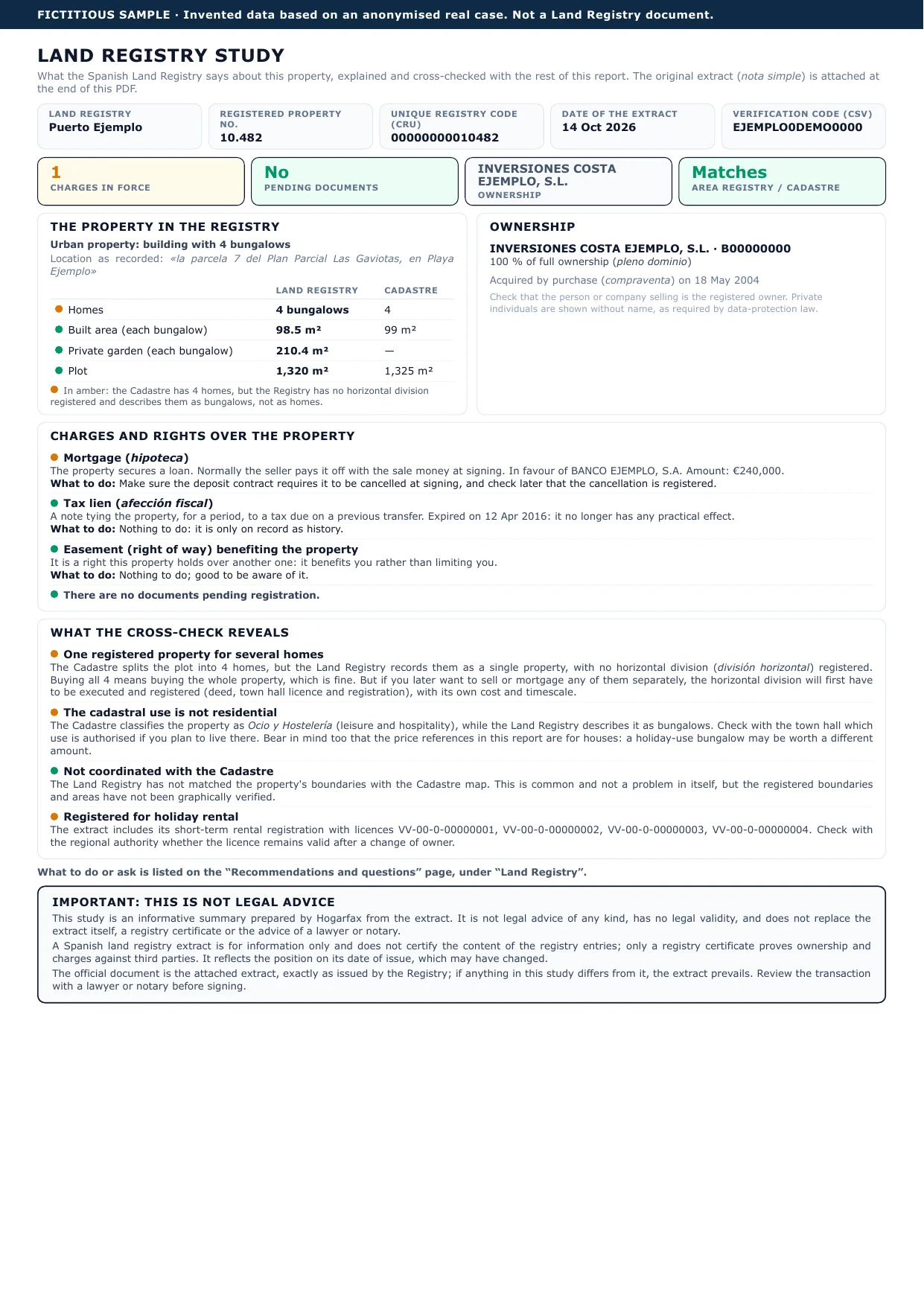
As there were two properties, the buyer ordered the Land Registry Study and Hogarfax requested two notas simples from the Land Registry, one per property. Each has its own page in the report, explained in plain English, and both originals are attached at the end of the PDF. This is what they confirmed:
- Both properties exist and have the same owners. A married couple under community property: both must sign the sale. Had one property belonged to someone else, the report would have flagged it in red.
- No charges. No mortgage or seizure. Only expired tax liens and, on the storage building, an expired article 207 Mortgage Law limitation (the one for properties registered for the first time): nothing to do.
- No documents pending registration on either property.
- Areas: the house as registered, adding up its three floors, matches the Cadastre. So does the storage building. The extra metres were the listing's, not the Registry's.
The property history: 35 years in one timeline
Notas simples don't only say who owns the property and what charges it carries: they also have dates. Hogarfax puts them in the report's timeline, next to what the Cadastre says and what other people contribute. In this case they told the full story:
- 1989 · Purchase of the plot, registered at the Land Registry.
- 1995 · Deed declaring the new house and its registration.
- 1996–1997 · Built according to the Cadastre; works completed according to the Registry.
- 2007 · The same owners buy the adjoining plot.
- 2013 · First registration of that property and declaration of the new storage building.
- 2026 · Put on sale, offer and counteroffer (contributed by the buyer) and both notas simples obtained for the report.
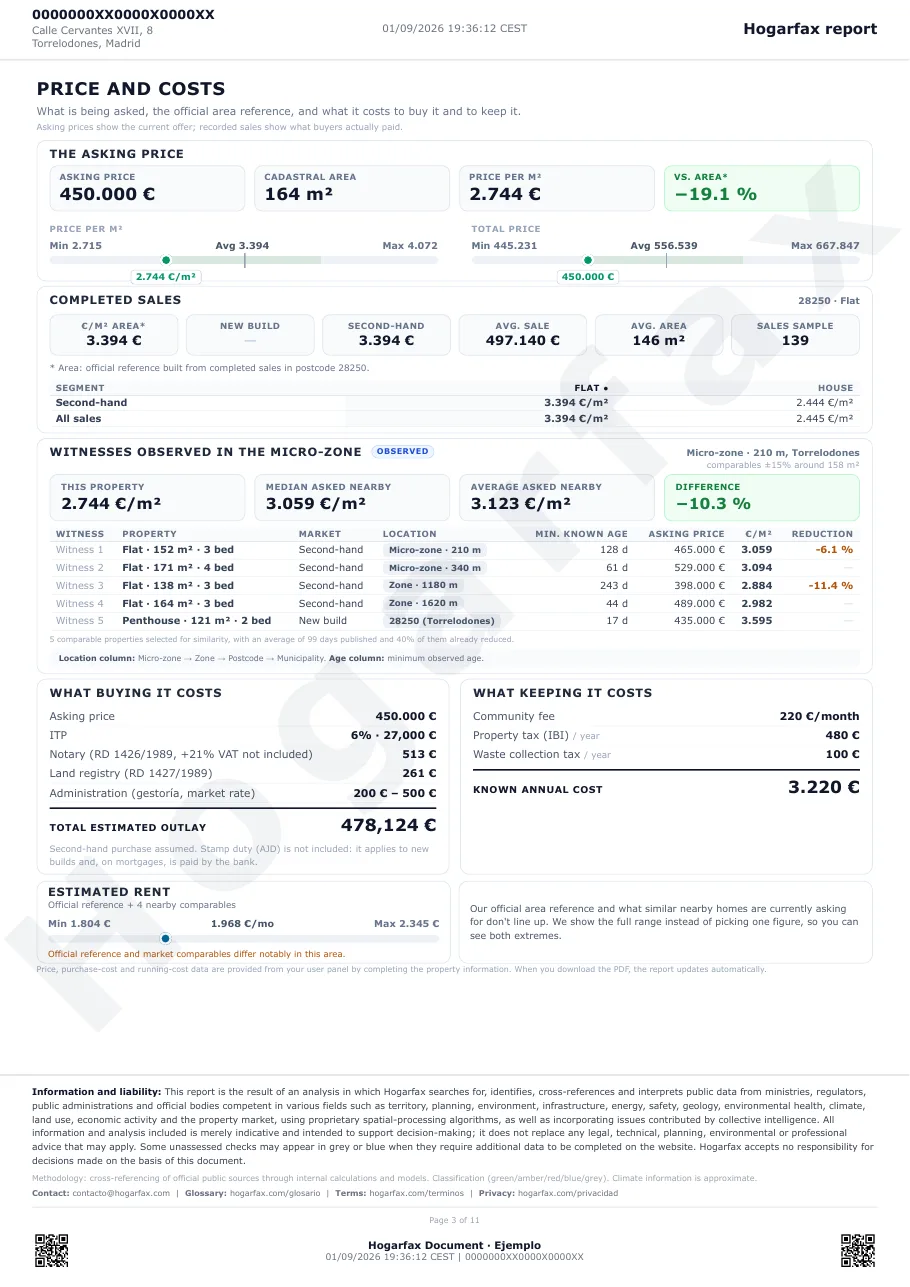
That timeline explains things no listing tells you: that the storage building is twenty years younger than the house, that this is why it sits on another property, and that its industrial use is not a mistake but what was declared. With the asking price, the offer and the counteroffer in the same chart, the buyer negotiated with facts, not impressions.
How the buyer came out of it
Well informed. They knew they were buying two properties and that both had to be in the contract and the deed; that both belonged to the same sellers and were free of charges; how many square metres the house really had; what they could and could not do with the storage building; and which surrounding risks to check before signing. All from official sources and in their language.
Is the house you like a single property?
Analyse it before paying a deposit: plots, cadastral use, risks, areas and the real local price, from official sources. If you need it, order the Complete Report, with the nota simple.
Check a propertyFuentes
Was this article useful?
Your answer helps us improve the blog and understand which guides deserve more depth.